25. TML Performs Entity Level Machine Learning and Processing
25.1. What does entity level processing and machine learning mean?
An entity is any device or object that produces real-time data. TML processes data from individual devices or objects. This means TML can create machine learning models for each invidual device.

Important
The power of real-time entity based processing and machine learning means that if there are 1 million devices generating data, TML can create 1 million machine learning models for each device.
Because each device or object operates in its own environment - by processing each device invidually - TML offers a much deeper understanding of the behaviour of that device, and therefore able to predict the future behaviours of that device more accurately.
TML uses JSON PROCESSING to process JSON messages streaming to Kafka.
25.2. TML Processes Real-Time Data Using Sliding Time Windows
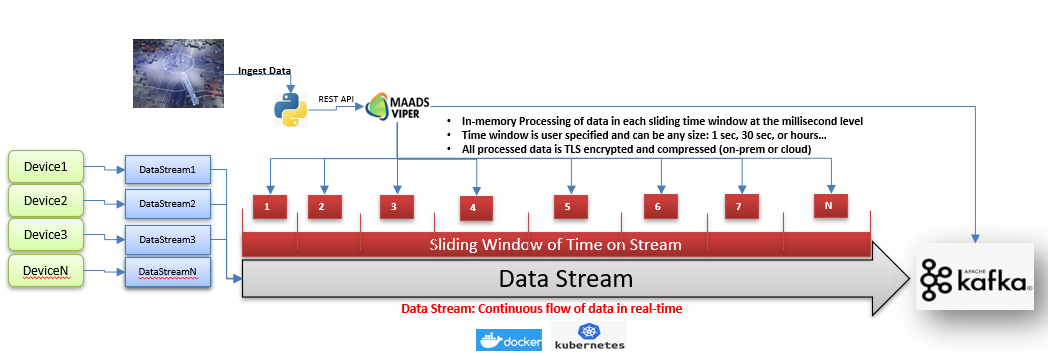
Attention
TML performs in-memory processing of data in the Kafka Topic using TWO components across all sliding time windows. See: STEP 4: Preprocesing Data: tml-system-step-4-kafka-preprocess-dag
REST API connect MAADSTML python script to MAADS-VIPER
35+ different processing types: min, max, dataage, timediff, variance, anomaly prediction, outlier detection, etc…
Apache Kafka is the central source of both input and output data – no external real-time database needed
No SQL queries are made for processing and machine learning
All TML solutions are containerized with Docker and scale with Kubernetes
25.3. TML Machine Learning Using Sliding Time Windows

Attention
TML performs in-memory machine learning of data in the Kafka Topic by joining data streams using THREE components across all sliding time windows:
REST API connect MAADSTML python script to MAADS-VIPER and MAADS-HPDE
5 different algorithm types: logistic regression, linear regression, gradient boosting, neural networks, ridge regression
Apache Kafka is the central source of both input and output data for estimated parameters – no external real-time database needed. See STEP 5: Entity Based Machine Learning : tml-system-step-5-kafka-machine-learning-dag
TML auto-creates individual machine learning models for each Device at the “entity” level and joins datastreams 1-3 for each device and user specifies
“Dependent” variable streams, and “Independent” variables streams